
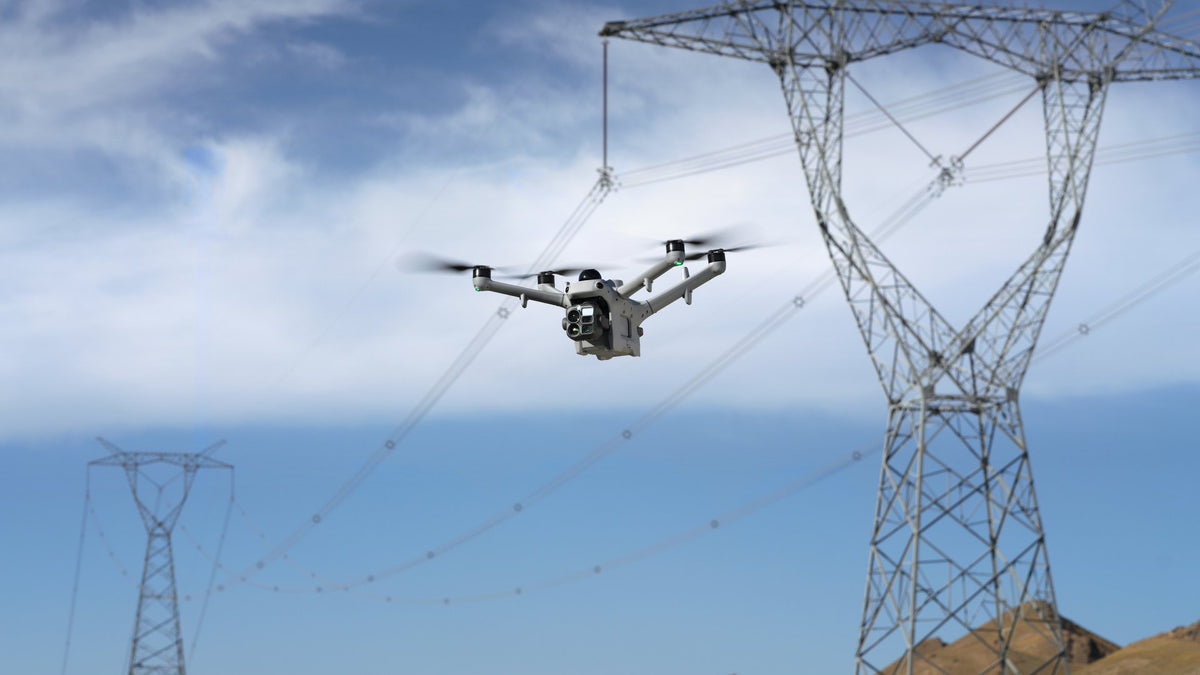
Choosing a Dock 3 aircraft means choosing its shift. The Matrice 4D maps, and the Matrice 4TD carries the thermal camera for patrol and inspection. Dock 4 has one aircraft, the Matrice 5TD, and DJI pitches it as one aircraft for two shifts.
DJI's Dock 4 product intro deck of 13 October 2026 puts the 5TD and the Matrice 4D and 4TD on one spec matrix, and the figures below come from it. We have not flown the 5TD. DJI opened orders on 14 October, with no local release date yet.
The camera stack, side by side
| Matrice 4TD | Matrice 5TD | |
|---|---|---|
| Wide | 1/1.3" CMOS, 48 MP, 24 mm, f/1.7 | 1/0.98" CMOS, 50 MP, 23.5 mm, f/1.8 |
| Medium tele | 1/1.3" CMOS, 48 MP, 70 mm, f/2.8 | 1/1.28" CMOS, 50 MP, 70 mm, f/2.88 |
| Tele | 1/1.5" CMOS, 48 MP, 168 mm (7×), f/2.8 | 1/1.5" CMOS, 50 MP, 252 mm (11×), f/2.8 |
| Max hybrid zoom | 112× | 176× |
| Thermal | 640 × 512, 12 μm, f/1.0 | 1280 × 1024, 8 μm, f/0.85 |
| Thermal super-resolution | 1280 × 1024 | 2560 × 2048 |
| Laser rangefinder | 1,800 m at 20% reflectivity | 3,000 m at 25% reflectivity |
Focal lengths are 35 mm equivalents. The thermal core has four times the pixels of the 4TD's. The rangefinder figures are measured at different target reflectivity, 20 per cent for the 4TD and 25 per cent for the 5TD, and DJI gives the 5TD's ranging accuracy as plus or minus 50 cm plus 0.1 per cent of the distance.
Two working changes come with the cameras. One shutter press captures the wide and telephoto frames together, where the 4TD captures one or the other. Thermal fusion has four views: picture-in-picture, MSX blending across the shared field of view, edge outlines on the visible image and a thermal overlay inside a region. DJI notes the two layers stop lining up once the zoom passes the thermal lens coverage. It also claims panoramas 2.4 times faster than on Dock 3.
Night work leans on the 11× tele
The 11× camera uses an RYYB sensor. Yellow filters in place of green pass both green and red light, and DJI puts the gain at about 30 per cent more light than a standard RGB filter. The processor merges frames at up to 20 Hz for 4K night video, and DJI gives a maximum night-mode ISO of 1,638,400, two to four times the 4TD by its count. A near-infrared illuminator works with night vision for covert work.
Mapping from a patrol airframe
DJI's mapping figure for the 5TD is an aerial-triangulation check-point accuracy of around 10 cm, flown at 120 m, nadir or oblique, without terrain following, with each 50 MP frame merged down to 12 MP. The 5TD uses an electronic rolling shutter on a 13.1 × 9.8 mm sensor, and DJI says the onboard chip and its Terra SDK processing compensate for the error that adds. The Matrice 4D on Dock 3 keeps a mechanical shutter on a 17.3 × 13.0 mm sensor.
That puts mapping on the same aircraft that patrols the site. Where mapping is the dock's main output and check points set the tolerance, we would still quote Dock 3 with the Matrice 4D first, and ground control stays in the plan on either aircraft.
Longer flights and sensing in the airframe
DJI lists 59 minutes maximum flight time against 54 for the 4TD, 55 minutes hover against 47 and 48 minutes as a practical operating time. FlyTo runs at up to 21 m/s, which DJI turns into a target 3 km away in under three minutes. The 5TD is rated from -40 °C (the 4TD from -20 °C) and stays at IP55 and 12 m/s wind resistance. It is also heavier, 2,600 g against 1,850 g, on a 260 Wh battery against 149.9 Wh.
Obstacle sensing is built in. The 5TD combines six full-colour vision cameras, LiDAR, a 3D infrared sensor and millimetre-wave radar, and DJI shows it stopping before a power line. On the 4TD the radar is an optional accessory that costs flight time. The 5TD also carries a flight termination system in the airframe, a customisable warning light with red and blue flashes, a real-time altitude alert and Remote ID detection of DJI aircraft within 200 m where Remote ID is in force.
Onboard AI and the payload
Onboard detection grows from three target types on the 4TD (people, vehicles and vessels) to 17 on the 5TD. The new list covers people and vehicles filterable by colour, smoke and fire, cows, horses and sheep, plus sedans, buses, dump trucks, forklifts, excavators, cargo trucks, tankers, bicycles, motorcycles and river debris. For your own models DJI quotes up to 100 TOPS of onboard compute (it names YOLOv8 and YOLOE) and three E-Port V3 ports for Payload SDK accessories. The 450 g payload carries the AS2 Speaker, AL2 Spotlight and AP1 Parachute at once.
The dock side of the change, from the battery swap to the O4 Ground Station, is in our Dock 4 vs Dock 3 comparison. Send us the site and what the aircraft has to find by day and by night, and talk through the job with us.